Cleaning single dental implants
Although a dental hygienist can clean the implant's abutment and the crown, the patient must also perform daily maintenance. Signs of improper home care include:
- Bleeding
- Red and swollen gums
- Pain when chewing
- Bad breath
- Bad taste in the mouth
Taking a small amount of extra care when cleaning a single dental implant can shield surrounding teeth from bacteria and increase its longevity.
Brushing
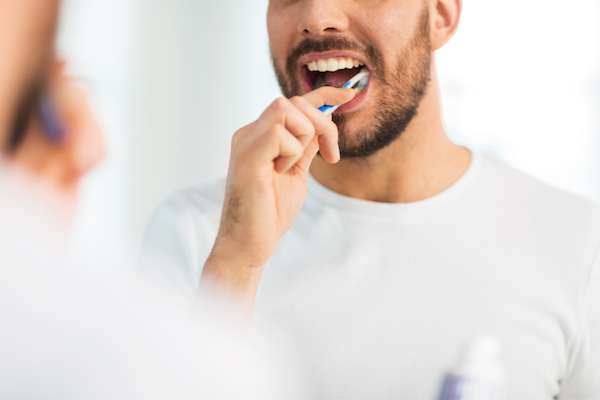
Brushing twice per day is necessary for patients with and without implants. Patients with dental implants must gently brush the crown, using a soft nylon brush to avoid scratching its surface. Oral bacteria can migrate into the jaw through scratches on the crown.
Using mild toothpaste
Unlike natural teeth, implant crowns have an acrylic surface that abrasive substances such as baking soda can wear away. Worn surfaces create access points for bacteria that can infect the jaw and the tissue around the implant. Brushing with a mild toothpaste eliminates this concern.
Water flossing
Water flossers have parts that can direct water flow deep inside the space between the crown and the gums where bacteria accumulate. A pulsating hydraulic force of room temperature water washes away plaque and debris and is gentle enough to apply every day.
Alternative flossing
Soft interdental brushes can achieve the same level of cleaning that water flossing provides. Standard string floss is inadvisable for use near dental implants because it can shred and enter the gum tissue causing infection. Specially designed floss consisting of shred-resistant stiff ends and a pliable middle can safely clean the area where the crown's edge meets the gumline.
Gum stimulating
Patients can gently massage the gums with stimulators to send nutrient-rich blood to the implant region. A gum stimulator is also an excellent cleaning device consisting of a long metal or plastic arm supporting a small triangular-shaped rubber or silicone tip that reaches beyond the gumline near the implant crown to scrape away plaque. It can enter the tight space between the crown and other teeth to loosen trapped debris.
Cleaning implants that support bridges and dentures
Whether a patient has a single implant or multiple implants, the cleaning methods are the same, with some variation. Additional tools in a home care arsenal can benefit patients with implant-supported bridges and dentures.
Interdental brushing
Patients can use small, narrow brushes with soft bristles to clean implant-supported bridges or dentures near the gumline where standard toothbrushes cannot easily reach. Subtle changes in design depend on which part of the mouth is cleaned.
Mouth rinsing
A mouth rinse can penetrate spaces that other home care tools can not reach. Antibacterial rinses can dislodge debris while killing germs that can cause periodontitis.
Conclusion
Dental implants can last a lifetime with proper cleaning. Rigorous home care is essential but does not take the place of in-office deep cleaning.
Request an appointment or call Brede Ciapciak Dental at 781-443-8134 for an appointment in our Needham office.
Recent Posts
Permanent tooth loss can be devastating, affecting your appearance as well as your oral and overall health. Fortunately, dental implants give people the opportunity to fully restore their smile with a prosthetic replacement. There are many benefits to choosing dental implants to replace lost teeth, including: Lower risks for bone loss Natural-looking results Protection from…
Many people assume that only a small group qualifies for dental implants. On the contrary, a wide range of adults are eligible to replace teeth with this popular smile restoration. To start, most candidates simply need to be in good health, have a strong jawbone, and practice good oral hygiene. A dental provider looks at…
Dental implants replace tooth roots, anchoring right into the jawbone. They support natural chewing forces, protect the jawbone from tissue loss, and stabilize confident smiles. This design makes them a smart investment for those seeking a long-term solution to replace missing teeth. While dental implants can last a lifetime, their longevity depends on proper care…